Nova Scotia Mathematics Activities & Resources
  • Home
  • About
  • Calculus 12
    • CAL12 Limits and Continuity
    • CAL12 Derivatives
    • CAL12 Applications of Derivatives
    • CAL12 The Definite Integral
    • CAL12 Techniques of Integration
  • Pre-calculus 12
    • PCAL12 Function Transformations
    • PCAL12 Radical Functions
    • PCAL12 Polynomial Functions
    • PCAL12 Trigonometry
    • PCAL12 Exponential and Logarithmic Functions
    • PCAL12 Rational Functions
    • PCAL12 Function Operations
    • PCAL12 Permutations and Combinations
  • Mathematics 12
    • MT12 Polynomial Functions
    • MT12 Exponential Functions
    • MT12 Sinusoidal Functions
    • MT12 Financial Mathematics
    • MT12 Set Theory and Probability
    • MT12 Numerical and Logical Puzzles and Games
    • MT12 Research Project
  • Mathematics at Work 12
    • MTW12 Measurement and Probability
    • MTW12 Statistics
    • MTW12 Linear Relations
    • MTW12 Finance
    • MTW12 Geometric Figures and Transformations
    • MTW12 Trigonometry
    • MTW12 Logical Puzzles and Games
  • Mathematics Essentials 12
    • MTHE12 Module 1
    • MTHE12 Module 2
    • MTHE12 Module 3
    • MTHE12 Module 4
  • Pre-calculus 11
    • PCAL11 Sequences and Series
    • PCAL11 Quadratics
    • PCAL11 Systems of Equations
    • PCAL11 Radicals
    • PCAL11 Trigonometry
    • PCAL11 Rationals
    • PCAL11 Absolute Values
  • Mathematics 11
    • MT11 Systems of Linear Inequalities
    • MT11 Quadratics
    • MT11 Logical Reasoning
    • MT11 Angles and Triangle Trigonometry
    • MT11 Statistics
    • MT11 Proportional Reasoning
  • Extended Mathematics 11
    • MTEXT11 Systems of Linear Inequalities
    • MTEXT11 Quadratics
    • MTEXT11 Logical Reasoning
    • MTEXT11 Angles and Triangle Trigonometry
    • MTEXT11 Proportional Reasoning
    • MTEXT11 Sine and Cosine Law
    • MTEXT11 Statistics
    • MTEXT11 Data Analytics
  • Mathematics at Work 11
    • MTW11 Surface Area, Volume and Capacity
    • MTW11 Scale
    • MTW11 Statistics
    • MTW11 Finance
    • MTW11 Slope and Rate of Change
    • MTW11 Right Triangle Trigonometry
    • MTW11 Numerial Puzzles and Games
  • Mathematics Essentials 11
    • MTHE11 Data Management
    • MTHE11 Housing
    • MTHE11 Banking
    • MTHE11 Measurement
    • MTHE11 Taking a Trip
    • MTHE11 Mental Math
  • Mathematics 10
    • MT10 Measurement
    • MT10 Trigonometry
    • MT10 Polynomials
    • MT10 Real Numbers
    • MT10 Relations and Functions
    • MT10 Linear Functions
    • MT10 Systems of Linear Equations
    • MT10 Financial Mathematics
  • Mathematics at Work 10
    • MTW10 Unit Price and Currency Exchange
    • MTW10 Measurement
    • MTW10 Angles and Parallel Lines
    • MTW10 Pythagorean Theorem
    • MTW10 Trigonometry
    • MTW10 Earning an Income
    • MTW10 Spatial Puzzles and Games
  • Mathematics Essentials 10
    • MTHE10 Earning and Purchasing
    • MTHE10 Banking
    • MTHE10 Measurement
    • MTHE10 Geometry
    • MTHE10 Transportation and Travel
    • MTHE10 Probability
    • MTHE10 Mental Math
  • Mathematics 9
    • MT9 Powers and Exponent Laws
    • MT9 Rational Numbers
    • MT9 Square Roots and Surface Area
    • MT9 Linear Relations
    • MT9 Polynomials
    • MT9 Linear Equations and Inequalities
    • MT9 Similarity and Transformations
    • MT9 Circle Geometry
    • MT9 Probability and Statistics
  • Mathematics 8
    • MT8 Square Roots and Pythagorean Theorem
    • MT8 Integers
    • MT8 Operations with Fractions
    • MT8 Measuring Prisms and Cylinders
    • MT8 Percent, Ratio, and Rate
    • MT8 Linear Equations and Graphing
    • MT8 Data and Probability
    • MT8 Geometry
  • Mathematics 7
    • MT7 Integers
    • MT7 Geometry - Transformations
    • MT7 Fractions, Decimals, and Percent
    • MT7 Linear Patterns and Relations
    • MT7 Circles and Area
    • MT7 Operations with Fractions
    • MT7 Equations
    • MT7 Data Analysis
    • MT7 Geometry - Constructions
  • Contact

mathematics 7 Integers

Specific Curriculum Outcome

N06     Students will be expected to demonstrate an understanding of addition and subtraction of integers, concretely, pictorially, and symbolically.

N06 activities

  • 123 Switch! from Tom DeRosa - A card game using integers. Students use their cards to make a true equations. First player to get rid of all their cards wins.
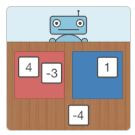
  • Adding Integers Desmos Activity - In this activity, students practice adding integers in the context of a card game. The goal of the game is to create two groups of cards, each with the same sum. Whoever uses the most cards wins! Also available in French. 
Picture
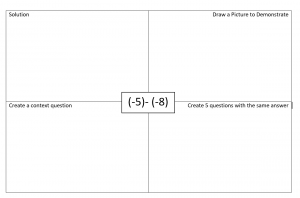
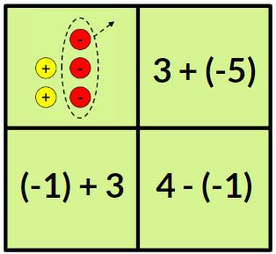
  • Deeper Learning with Integers from Gillian Mathewson - Gillian describes her work using manipulatives with students for adding integers. She also shares a practice handout she gives to students to demonstrate their understanding of selected integer expressions in a variety of ways. The four regions on the sheet are for: a solution, a picture to illustrate the expression, a context question and 5 expressions with the same value.
Picture
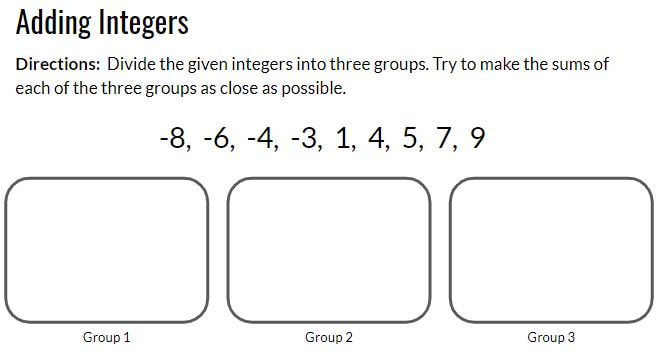
  • Adding Integers Open Middle Problem - Divide the given integers (-8, -6, -4, -3, 1, 4, 5, 7, 9) into three groups. Try to make the sums of each of the three groups as close as possible. Next ask students to create their own list of integers and repeat the problem.
Picture
  • Integers Clothesline Game from Andrew Stadel - ​Build and strengthen conceptual understanding of adding & subtracting integers using an integer clothesline.  Teams work to land on a target number first by adding or subtracting integers on a number line.
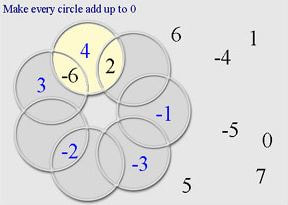
  • Circle 0 from NLVM - Solve a puzzle by moving numbers around so that the sum of three positive and negative integers is zero. The online version has issues with Java but you could make a paper and pencil copy as well.
Picture
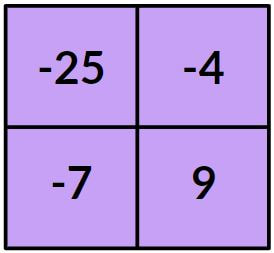
  • Which One Doesn't Belong - Ask students to select one of the four numbers and justify why they think it is different than all the rest. There are no wrong answers as long as a justification accompanies it. Check out http://wodb.ca/ for lots of additional suggestions. 
Picture
Picture
  • Integer Bingo from Ilona Vashchyshyn - Draw random integers (-4 to 4) and add them together. If the sum is on the student's bingo card, they can cross the number off.  Start with random bingo cards for the first round and then let them make their own bingo cards for the second round. Great integer addition practice as well as a bit of probability.
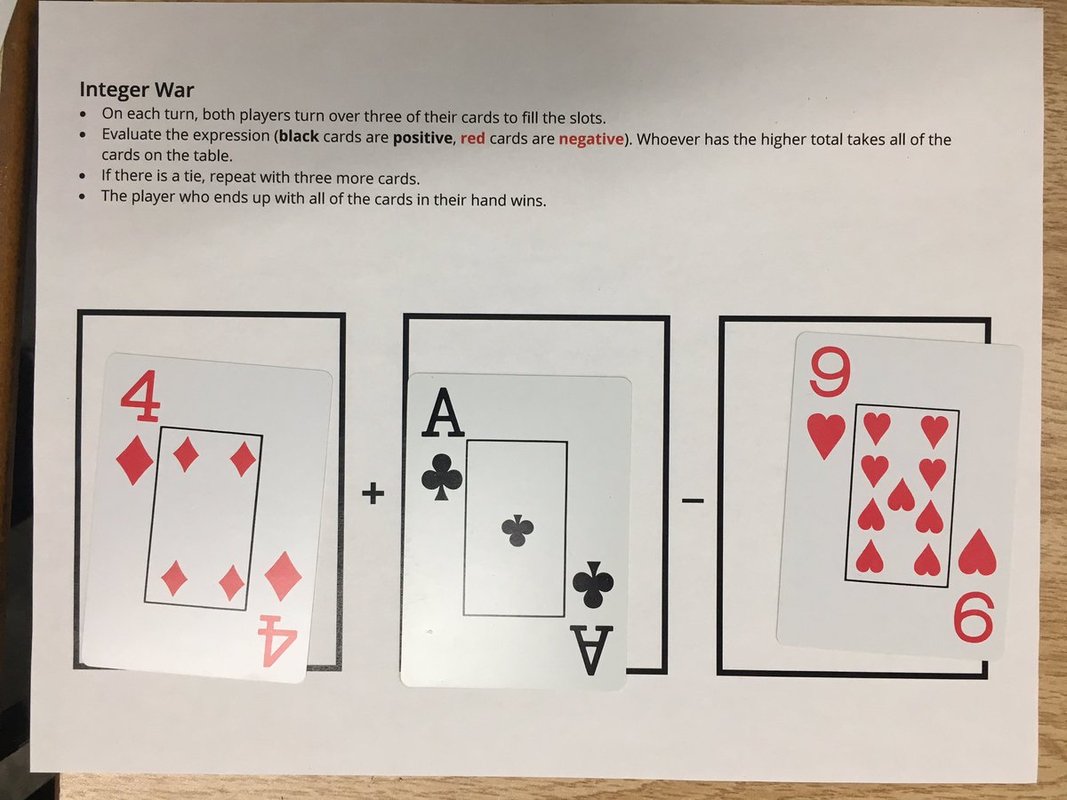
  • Integer War from Ilona Vashchyshyn - Both players turn over three cards. Evaluate the expression (black cards positive and red cards negative). They player who has the higher total claims all six cards.
Picture
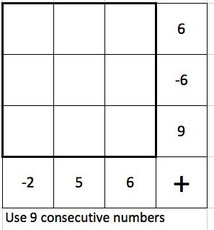
  • A Yohaku Puzzle from @YohakuPuzzle - Fill in the cells with 9 consecutive integers to get the sums shown in each row/column.
Picture
  • Zip, Zilch, Zero Card Game from NCTM Illuminations - Players try to make a sum of zero using cards 2 or more cards from their hand. Black cards are positive integers and red cards are negative integers. Students build understanding of adding integers while playing this game game involving both strategy and luck,
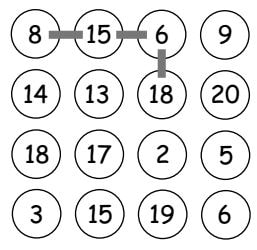
  • Joins (inspired by problem 54 from Mathematical Challenges for Able Pupils) - Join any four numbers on a 4x4 grid filled with integers. Students can create their own or the teacher could provide a grid already filled. Find the total of the four joined numbers. Joins can go up, down or sideways, but not diagonally. Find the highest possible score. Find the lowest possible score. Find the score closest to zero. Now try joining five numbers. Here is a link to a google doc handout I made for this.
Picture
Example: The score shown is 47.
  • Adding and Subtracting Directed Numbers from The Mathematics Assessment Project - This lesson unit helps students to add and subtract directed numbers (positive, negative and zero) with understanding. It introduces the charge model for directed numbers and asks students to match diagrams with calculations and produce missing diagrams for the remaining calculations.
  • Working with Integers from Mary Bourasa - Mary uses a hot air balloon as an analogy for positive and negative integers.  Each balloon is a +1 and each sandbag is a -1.  There never seem to be a shortage of stories about people attaching balloons to a lawn chair and launching into the sky.  I would start class with an image like the one at right and ask student to estimate how many balloons there are an how high they think this guy ascended.  Kent Haines has a Balloon/Sandbag integers game.
Picture
  • Downside-Up from Mathelicious - Happiness, and the lack thereof, is on the mind of every student in our classroom. As a result, students often have strong opinions about happiness, sadness, and the space between. Do bad days make good days feel better? Is it better to have a steady, small level of happiness, or to swing wildly from elation to misery and back?  In this lesson, students use integers to compare good and bad days and use absolute value to explore what happens when we reinterpret negative moments in a more positive light.

Powered by Create your own unique website with customizable templates.